
7 Elements of Art - Line
- Najra

- 13 godzin temu
- 9 minut(y) czytania
Hello Humans.
In art, just like in music or literature, there are fundamental components that the artist combines to create an artistic whole. Getting to know the 7 elements of art is a perfect starting point to understand how to create works of art using various techniques. The elements help you consciously build compositions, messages, and emotions, and most importantly, this does not depend on the technique. So whether you create with paints, pencil, pastels, or anything else, these elements are universal for every technique.
In this blog:
What is Line in Art?
Why is Line So Important?
History and Evolution of the Approach to Line
PDF to download
Summary
What is Line in Art?
Line is probably the first and simplest shape that comes to mind in art. It's thanks to lines that we sketch/draw/divide/mark/underline from the earliest years.That's why line quickly became one of the basic 7 elements of visual arts.
In the official definition, a line is a mark left by a tool on a surface without a predetermined length, width, or depth. It is a tool of expression that tells stories, outlines emotions, guides the eye, conveys feelings, creates the illusion of space, or gives rhythm to a composition.
The applications of line in art are infinite; what truly limits us is its technical understanding and creative use. The most popular ones are outlines, contours, one-liners, sketches, contrasts, and patterns.

Why is Line So Important?
Line is one of the fundamental elements; it serves countless functions, from purely technical to deeply emotional. The most obvious is outlining shapes, for example in sketches, but that's just the tip of the iceberg. In reality, line is a carrier of energy, emotion, and thought for the artist.
Line is the first trace of humanity (and consciousness).
Before humans could write, read, or consciously develop knowledge or art, the line was already present in their lives. It was the first artistic act of humanity – a line carved into rock. It is the most direct record of the movement of the hand and thoughts working together, consciously and out of a need deeper than mere survival. In contemporary art, the line still plays a significant role; it is often deliberately chosen by artists as an authentic and unique carrier, despite its apparent simplicity. As in the example below, this is a painting by a renowned artist, Cy Twombly, who consciously chose lines for his work "Untitled, 1966."

Line defines boundaries and space.
Probably the most obvious form of line is the outline (contour). The artist defines where, for example, an apple ends and the table begins. Although, importantly... Line does not actually exist in reality; objects, people, or the horizon are not outlined in any way, yet the human brain 'created' lines in a sense to categorize reality more easily. Therefore, by drawing lines, the artist makes it easier to understand their work. It almost translates three-dimensionality onto a two-dimensional plane, making the observer understand the message.
Line carries emotional and psychological charge
Horizontal line – calms, suggests peace and stability (horizon).Vertical line – expresses dignity, sublimity, strength (columns, trees).Diagonal line – introduces tension, dynamics, unease (fall, run).Curved/wavy line – associated with fluidity, grace, nature (female body, water).Zigzag/broken line – expresses aggression, chaos, pain (expressionism).

Creates rhythm and guides the viewer's eye
The line acts as a guide. The artist uses it to lead the viewer's eye across the canvas – from point A to B, creating composition. Repeating lines create rhythm (e.g., in Japanese woodcuts or Van Gogh's works), which gives the painting pulsating life.
Line conveys texture and light
Without lines, there are no techniques such as hatching or cross-hatching. The density, direction, and pressure of lines determine whether a surface appears smooth as silk, rough as tree bark, soft as a cloud, or hard as metal. The density of lines also creates the illusion of shadow and chiaroscuro (value).
It is the most universal tool of abstraction
In abstract art (e.g., in Piet Mondrian or Wassily Kandinsky), the line ceases to describe objects and begins to describe ideas – relationships between forces, cosmic order, or pure spirituality. It becomes an end in itself.

Democracy and speed
The art of line (drawing) is the fastest form of communication. The artist needs only a few seconds to sketch an idea that comes to mind. Unlike oil painting, which requires hours of drying, line captures a fleeting moment.
History and Evolution of the Approach to Line
Antiquity and the Middle Ages: Line as a Sign and Canon- Cave art (Lascaux, circa 17,000 BC)
The contour line (black, charcoal) was the first way to 'capture' the soul of the animal. Painters used the bulges of the rocks, but it was the line that defined the shape of the bison or horse.

Ancient Egypt
Line was strictly geometric and hierarchical. In tomb painting, the contour line was sharp, clean, and of uniform thickness. Its purpose was not to render perspective, but to ensure the spiritual endurance of the depicted figure.

Ancient Greece
The best examples are vases. The background was often painted black, while the contour lines of the figures were left in the color of the clay. Here, the line became more fluid and internally varied, to render the contours of muscles and drapery – the first naturalism of line appears. Other vases were equally often decorated with lines depicting ornaments, patterns, plants, animals, or scenes from life and legends.

The Renaissance (15th–16th century): Line as a Scientific Foundation ("Disegno")
The Renaissance saw the absolute cult of line. In Italy, the concept of Disegno was born – the intellectual project that precedes painting. Line became the test of an artist's skill.
Leonardo da Vinci (Anatomical sketches and "Vitruvian Man")
Line not only outlines but reveals cross-sections of everything inside. His sketches are investigative lines, trembling, searching for the truth about the structure of the body and machines. Line was a very important element in the development of not only art but also knowledge in various fields.

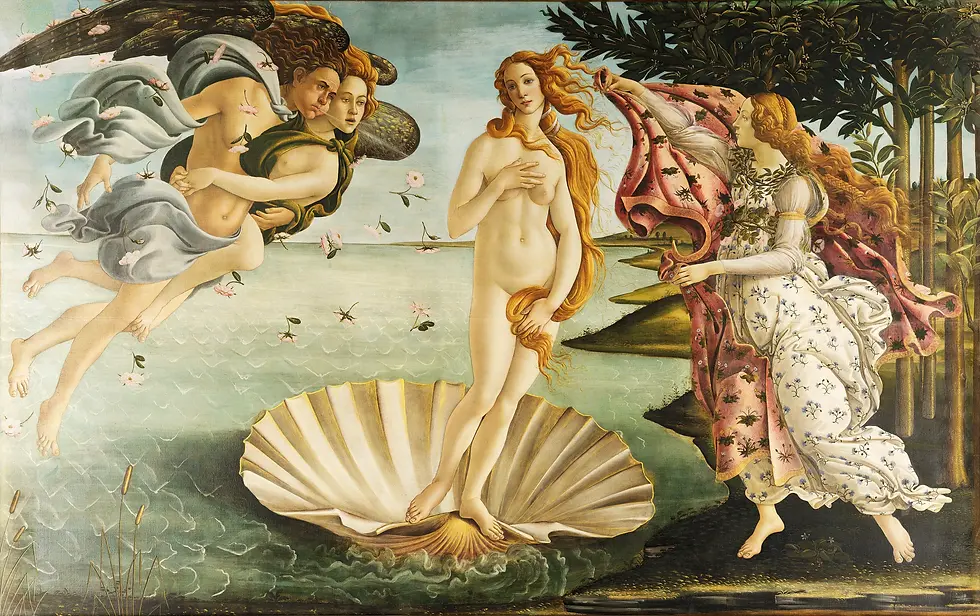
Sandro Botticelli ("The Birth of Venus")
Here, the line is ethereal and wavy. Botticelli uses a very strong and fluid line (black contour) to render wind, hair, and folds of fabric. It is a decorative line that negates the physical weight of the body, lending divinity. Line here is the most essential form of guiding the eye across the painting.
Mannerism (Parmigianino)
The line undergoes elongation and bending (the so-called figura serpentinata – a line shaped like the letter S). In the painting "Madonna with the Long Neck," the line deliberately deviates from anatomy to achieve an effect of elegant, intellectual virtuosity. Line here is not the most essential part of the painting, but rather a tool to achieve a goal and highlight a specific part of the painting.

Baroque and Classicism (17th–19th century): The Battle of Line and Color
In the 17th century, a great dispute emerged (especially in France): which is more important – disegno (line and drawing) or colorito (color and light)?
Baroque (Rubens, Rembrandt)
Line loses sharpness in favor of the chiaroscuro patch. Line becomes soft, blurred, often lost in the darkness. In these paintings, we rather won't find specific, emphasized lines.

Neoclassicism (Jean-Auguste-Dominique Ingres)
This is a return to the cult of pure line.Ingres claimed that "line is virtue." His famous sketch "The Great Odalisque" is a manifesto – the line of the woman's back is deliberately lengthened by three additional vertebrae, because Ingres believed that the beauty of the line is more important than anatomical truth. It is a smooth, cool, marble-like line. Despite this slight elongation and the very obvious rendering of the line, it does not appear unnatural. Its subtle marking draws attention, guides the eye, but is quite subtle and deeply artistic.

Romanticism (Eugène Delacroix)
Ingres's opponent. Delacroix used broken, restless lines made with a quick brush to convey the dynamics of movement and the vehemence of emotion (e.g., in "The Massacre at Chios"). These two works do not differ in skill, but they illustrate a completely different approach. Here, the lines are less visible, shorter, less obvious, and much more jagged. Here, line served Ingres to convey the energy of the scene.

Post-Impressionism and Art Nouveau (end of the 19th century): Line as an Expression of Feelings and Stylization
Vincent van Gogh
Revolutionized line, treating it like handwriting. In "The Starry Night," there are no smooth contours – instead, there are short, wavy, vibrating strokes (impasto with a brush) that convey the whirl of air and the artist's inner tension. If compared to the other paintings above, one can see how very different his style was. The line shifted from subtle guidance of the eye and being merely marked in the painting to the forefront.

Art Nouveau (Secession) – Gustav Klimt / Alphonse Mucha
Line becomes a fluid, long, decorative arabesque. The line moves like a climbing plant, enveloping figures (golden, spiral patterns on garments in Klimt's works). Here, line symbolizes the organic life of nature.

20th Century Avant-Garde: Line as an Independent Subject
This is the most important turning point: line ceases to describe the object and begins to describe itself and absolute concepts.
Henri Matisse (Fauvism)
He said he dreamed of "an art of balance, purity, and serenity." In his later years, when he was already ill, he created a series of drawings and cut-outs where a continuous line (one stroke without lifting the hand) sketches a face. It's a line of essence – reducing form to a minimum to capture character.

Wassily Kandinsky (Abstraction)
In his book "Point and Line to Plane" (1926), he scientifically described lines as forces. He believed that the horizontal line is a cold, flat sound, the vertical is a warm, high tone, and the diagonal is movement. His abstract compositions are a record of emotions through pure lines without any object.

Piet Mondrian (Neoplasticism)
He reduced line to a black, straight, vertical or horizontal stroke cutting across the canvas. His lines are not the boundaries of fields but the structure of cosmic order. Line as a relationship (thicker here, thinner there, to balance the weight of colors).Line returned here again to the forefront and is very visible.

Contemporary and Conceptual Art (from the 1960s to today): Line as Action, Space, and Code
Action Art (Action Painting – Jackson Pollock)
Although it's splatters, his drip lines (dripping paint lines) are a record of the movement of the whole body. The line is no longer on the canvas – it is the canvas and a physical act. The lines remain visible and very significant.

Land Art (Richard Long)
Lines are no longer drawn on paper but trodden into the landscape (e.g., a simple track on grass). It's line as an intervention in nature, a trace of time. Line has gone beyond paper or canvas but remains very visible and openly displayed.

Digital and Generative Art
Today, lines are generated by algorithms (e.g., plotters, AI). Line returns to its mathematical roots but creates infinite fractals impossible to execute by hand. It can also recreate reality or return to previous examples, copying the use of line.
Exercises for Practicing and Understanding Line
Here are a few simple exercises that will help you better understand and pay more attention to lines in your works, so you can master the 7 elements of art through simple exercises.
Types of Lines:
It's impossible to use this element effectively without a solid understanding. Take a piece of paper and a pencil, pen, fountain pen, brush... The more different tools, the better the understanding.
Draw a series of lines, deliberately giving them different characters: thin, thick, dashed, dotted, zigzag, wavy, spiral, violent, lazily drawn, abrupt.
Use various tools, colors, and methods to create a full 'palette' of different lines for yourself.
When the paper is full, look closely at your lines. Notice that each expresses something slightly different, assign emotions to your lines, and experiment with application.
You can take another sheet of paper and divide it into emotional sections. (For example, in the upper right corner, all the lines created with anger.)
This may seem silly or pointless, but over time, as you start creating more works, as you begin trying to convey emotions through your art, this foundational knowledge will prove invaluable.
Line as Contour
Probably the most well-known and most frequently used purpose for line, but worth practicing, especially if you are just starting out or want to review the basics.
Place an object in front of you (e.g., a cup, a potted flower, a vase). Observe your object, but not just with the thought that it's nice or unappealing.Focus on technical observation: where are the edges, does the object have any elements that connect, are the edges straight or curved, large or small?
Guide your pencil across the paper, don't rush as you try to capture the shape you see. Start with simple general contour lines. Then, if you feel capable, add details and/or shadows using lines and strokes.
PDF to download
Here you will find a PDF I have prepared for line exercises. It will make it easier for you to test different techniques and materials and express emotions and feelings without worry.

Summary
Line is one of the 7 elements of art, through which the artist can better express their feelings. It is the simplest yet most powerful means of expression, from which the adventure with every form of visual art begins.
Thanks to the line, you will guide someone's gaze, reveal feelings, message, depth, and much more.


Komentarze